Mech Assemble: Zombie Swarm
- 4.5
- Rating
- 1.00M
- Installs
- Free
- Price

 Analysis by App-foxy
Mech Assemble: Zombie Swarm caught my attention because it puts a very clear image in your head: a customizable machine standing against an overwhelming undead crowd. After spending time with this free action game, I found that its strongest quality is not simply the promise of robots and zombies, but the way its visual direction, sound, and battle rhythm support the central feeling of being surrounded while gradually becoming more capable. It is easy to understand within a few moments, yet there is enough room in its build choices to make each run feel like a small experiment.
The game comes from ONEMT SGP and is available for players using Android 7.0 or later. It has reached over a million installs and holds a 4.6 average from around 105 thousand ratings, which gives a useful indication of how broadly its straightforward action has connected with mobile players. It is free to start, with optional purchases ranging from $0.99 to $99.99 per item. I would approach it as a quick, repeatable action game rather than a deep console-style campaign, and that distinction matters when deciding whether it belongs on your phone.
Why the opening minutes work so well
My first impression was shaped by the contrast between the mech and the swarm. The machine feels like the point of control: a compact, readable hero that I can improve, while the zombies provide constant visual pressure around it. That relationship makes the early battles understandable without a long explanation. I always know what I am watching for: where the crowd is gathering, how much space remains, and whether my current build is strong enough to keep the pressure under control.
You May Also Like

 Blood Strike: 2.5 Anniversary
Blood Strike’s Loadouts Turn Every Drop Into a Tactical Gamble
A close look at Blood Strike’s custom loadouts: how fast access to signature weapons reshapes its battle royale rhythm, rewards preparation, and narrows the gap between fights.

 Pandora - Music & Podcasts
Pandora’s Music Is Easy to Start, but Harder to Recover
Pandora’s strength is its low-effort path from a seed to a station. Its weak spot is how much confidence it asks you to place in connection, setup, and quiet recovery.

 8 Ball Pool
 Is Built on Rivalries, Rematches, and Routine
A close look at the rivalries, rematches, shared routines, and unanswered safety questions that turn a quick pool match into a persistent mobile community.

 Samsung Music
’s Quiet Strength Is Playing What You Already Own
Its reach comes less from spectacle than from dependable access to a personal library. That simplicity is both the app’s strongest retention engine and its ceiling.

 AccuWeather: Weather Radar
AccuWeather Review: A Quick, Clear Forecast for Everyday Decisions
For everyday plans, the best forecast is the one you can understand quickly. AccuWeather makes rain timing, radar, and local conditions easy to act on, with a few trade-offs.

 Hill Climb Racing
Why Hill Climb Racing Still Turns Crashes Into One More Run
A tiny car, a bumpy hill and one more upgrade: Hill Climb Racing keeps resurfacing because its simple chaos makes every near-miss feel personal.
More From Our News Desk
View All News


This simplicity is a real advantage on a phone. I can start a session without remembering a complicated story or a large cast of characters. The game presents its fantasy quickly, then lets the action carry the experience. For someone who wants a short burst during a commute, a break, or a quiet evening, that directness is more useful than an elaborate introduction.
At the same time, the opening can create the wrong expectation for players who want a traditional action game with precise manual aiming and a long cinematic journey. The appeal here is closer to managing a moving combat problem than performing a sequence of carefully choreographed attacks. I am making decisions inside a stream of danger, watching the machine’s development, and reacting to the shape of the encounter. If you prefer deliberate level design or a strong narrative campaign, the basic structure may feel too repetitive.
The game’s Teen content rating also fits the presentation. The setting is built around zombie conflict and mechanical combat, so the mood is tense and aggressive, but it remains framed as stylized action rather than a realistic military simulation. That makes it easier to recommend to older teenagers and adults who enjoy the genre without wanting a grim survival experience.
A visual identity built around pressure
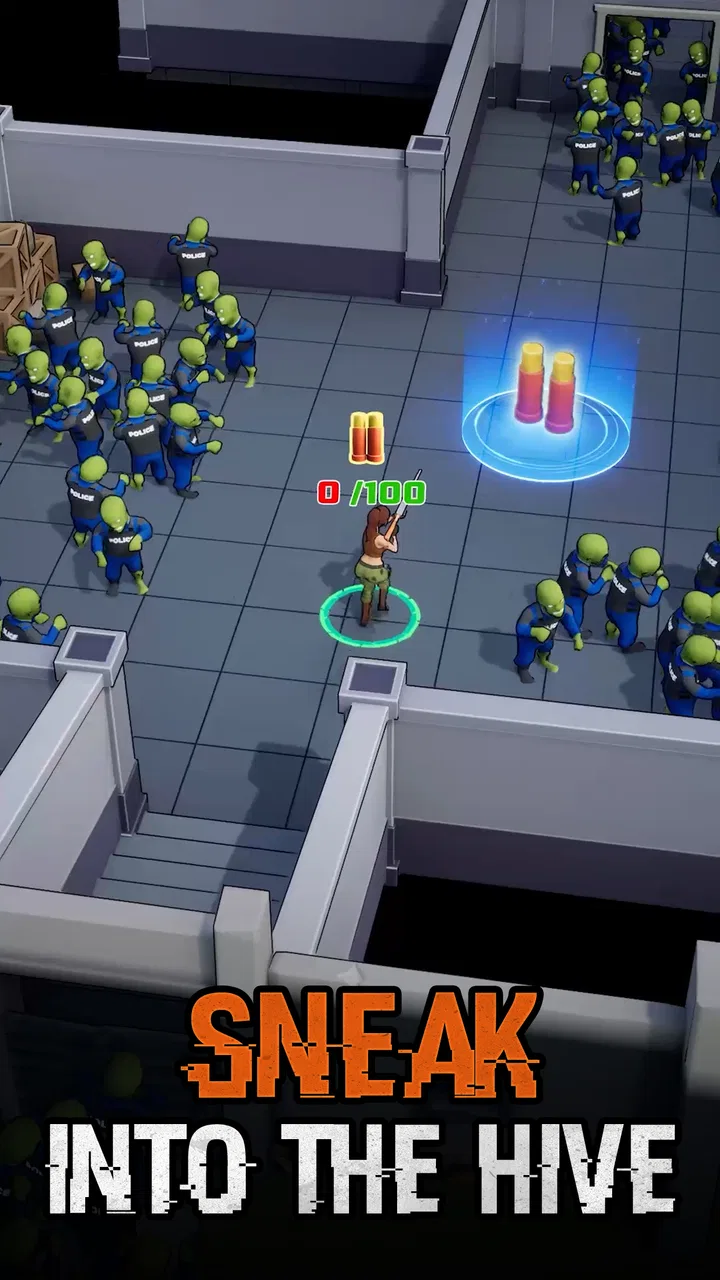
The art direction does useful mechanical work. The mech is visually distinct from the mass of enemies, and that separation helps me read the battlefield when several threats are approaching at once. A good swarm game needs to communicate danger immediately; if every shape blends together, the player spends more time deciphering the screen than making decisions. Here, the robot-versus-undead contrast gives the action a clear visual language.
I also like how the setting avoids needing much explanation. The ruined-world feeling is communicated through the opposition itself: an engineered machine, hostile crowds, and the sense that survival depends on keeping the machine moving and improving. The game does not need to pause constantly to explain why the world is in trouble. Its design tells me enough through the things placed in front of me.
That visual clarity becomes especially important when the screen grows busy. My practical advice is to watch the edges of the battlefield rather than staring only at the mech. The most dangerous moment is often not the group already close to the machine, but the next wave forming outside the immediate focus. Looking outward helps me notice where pressure is building and prevents the common mistake of reacting only after the crowd has closed in.
The trade-off is that a strong visual theme can become familiar quickly. The robot and zombie combination is immediately appealing, but it does not automatically provide variety. The long-term interest comes from how the machine develops and how I handle each encounter, not from expecting the setting alone to keep surprising me. Players who need constant environmental change may eventually find the presentation less compelling than the first sessions suggest.
Sound that keeps the battlefield moving
Sound has an important job in this kind of game because it reinforces the feeling of continuous danger. Mechanical actions and zombie pressure belong to different sides of the same soundscape: one suggests control and construction, while the other suggests numbers and disorder. When those elements work together, the audio makes the mech feel active even when I am concentrating on the wider battlefield.
I found that the rhythm of the game is easier to appreciate when I stop treating every moment as a separate fight. The experience works as a flow of pressure, release, and renewed pressure. A successful stretch gives me a brief sense of control, but the swarm keeps the mood from becoming comfortable for too long. That pacing supports the fantasy of a machine being assembled into something capable of standing its ground.
This also explains why the game is better suited to focused sessions than to passive play. I can listen for the change in intensity, but sound alone cannot replace watching the screen. The visual field remains essential, particularly when several threats compete for attention. I would use audio to strengthen immersion, not as a substitute for awareness.
For everyday use, I think the game works best with headphones when I want atmosphere and with the sound lowered when I am playing in a shared space. Its core remains understandable without turning the volume up, which is useful for a quick mobile session. Still, the mood loses some of its weight when the audio is removed completely, because the mechanical and zombie contrast becomes more dependent on visuals alone.
How the build-and-battle loop holds together
The central mechanical question is not simply whether the mech can defeat a crowd. It is whether the choices I make while improving it create a machine suited to the danger in front of me. That is where the roguelike structure earns its place. Each run encourages adaptation rather than relying on one permanent answer, and the appeal comes from seeing how a temporary combination performs under pressure.
I recommend treating upgrades as a plan instead of collecting whatever looks strongest in isolation. A build that improves immediate damage may feel excellent when enemies are close together, but it can leave me uncomfortable if the battlefield becomes harder to control. Conversely, a safer, more defensive direction may keep a run alive while producing slower progress. The useful question is not “Which option is best?” but “What problem is my current machine failing to solve?”
This is one of the less obvious strengths of the game: the swarm acts as a practical test of build quality. If enemies keep reaching the mech, I need to think about control and spacing rather than automatically chasing more damage. If the machine survives but cannot clear threats quickly enough, then endurance alone is not solving the run. I found that reading these failures is more satisfying than simply repeating the same upgrade pattern.
Another tip is to avoid changing direction too often. Early in a run, a few flexible choices can help me discover what the encounter is asking for. Later, scattering improvements across unrelated goals can produce a machine that does many things weakly. I get better results when I identify one main purpose for the build and use secondary choices to protect that purpose. This makes the mech feel assembled rather than randomly decorated.
The roguelike format also gives the game a natural reason to be replayed. A failed attempt is not only a loss; it shows where the current approach broke down. That said, replayability depends heavily on how much enjoyment I get from refining decisions. Someone looking for a fixed sequence of missions may see repeated runs as a limitation instead of a benefit.
Controls and presentation are designed around keeping the action readable rather than demanding complex input. That makes the game approachable, but it also means the satisfaction comes from positioning, timing, and build choices more than from mastering a large command list. Players who want the tactile precision of a traditional action title may find the interaction less demanding than expected.
Where it fits among mobile action games
Compared with a conventional shooter, Mech Assemble: Zombie Swarm places more emphasis on surviving a changing crowd and shaping the machine over time. I am not approaching every encounter as a test of manual accuracy. I am managing a moving threat, choosing how to develop the mech, and deciding when a safer option is more valuable than a flashy one.
Compared with a pure idle game, it asks for more attention. I cannot simply leave the phone untouched and expect the experience to feel complete, because the pressure of the swarm is the point. The game is most enjoyable when I am actively reading what is happening and making choices that respond to it. If your ideal mobile game progresses mostly in the background, this is probably not the right fit.
It also differs from story-heavy zombie games. The setting creates a strong mood, but the main pleasure is the battle loop rather than following a large narrative. I would choose this over a campaign-focused alternative when I want immediate action and repeatable sessions. I would choose a story-driven game instead if character development, dialogue, and a sense of journey matter more to me than build experimentation.
The free entry point makes it easy to test that distinction for yourself. You do not need to commit money before discovering whether the rhythm suits you. However, the in-app purchase range means players who are sensitive to monetization should decide in advance how they want to approach optional spending. I prefer treating purchases as unnecessary to the initial evaluation: first learn whether the core loop is enjoyable on its own, then decide whether any extra convenience is worth considering.
Who will enjoy it, and who should skip it
I would recommend this game to someone who likes compact action sessions, robot customization themes, and the satisfaction of improving a build after a difficult attempt. It is particularly suitable for players who enjoy asking why a run failed and adjusting their approach rather than expecting every attempt to unfold the same way.
A realistic use case is a ten-minute break between tasks. I can play a run, focus on one clear build idea, and stop when the session ends without needing to remember a complicated plot. It also works for a longer evening session when I want to compare different approaches and pay closer attention to how the mech handles the swarm.
I would be more cautious about recommending it to players who dislike repetition, want a carefully scripted adventure, or expect deep manual combat. The same structure that makes the game convenient can make it feel narrow: the visual theme is clear, the objective is direct, and the loop keeps returning to survival and improvement. That focus is a strength only if those are the parts of mobile action you already enjoy.
New players should also resist judging the game by one poor run. A weak attempt may reveal a mismatch between the build and the pressure rather than a simple lack of power. I find it more useful to remember the point where control was lost, then make the next run address that specific weakness. This turns repetition into a learning process instead of a chore.
Practical expectations before installing
The game is free, and its current version is 1.6.45. Its age rating is Teen, so it is aimed at an older audience rather than very young children. The Android requirement of 7.0 or later covers a broad range of devices, although the experience of a swarm game can still depend on how comfortably a particular phone handles busy action and how much screen space is available for reading threats.
I would install it when I want a focused action game rather than a social hub, a narrative adventure, or a passive progression tool. Before playing, I would decide whether I am in the mood for experimentation. The game rewards attention to the relationship between the machine, the crowd, and the available upgrades; it is less satisfying if I approach every run as something to rush through without observing what is working.
The developer, ONEMT SGP, has positioned the experience around a concise fantasy that is easy to understand on a mobile screen. That clarity is valuable, but it also places more responsibility on the battle loop to sustain interest. For me, the game remains engaging when I set a small goal for each session, such as testing a different build direction or learning how to respond earlier when the swarm begins to surround the mech.
My atmosphere verdict
What stays with me is the coherence between the art, sound, setting, and pacing. The mech gives the player a clear center, the zombies create constant visual pressure, and the audio supports the contrast between engineered control and chaotic threat. None of those elements needs to overpower the mechanics. Instead, they make the build decisions feel connected to the world: I am not just selecting improvements, I am trying to turn a vulnerable machine into something that can withstand a hostile crowd.
The game is not a universal recommendation. Its repeated structure, optional purchases, and lighter emphasis on manual combat will disappoint players searching for a large campaign or highly technical controls. But for me, that narrow focus is also why it works. I can understand the objective quickly, make meaningful adjustments within a run, and return later without needing a long refresher.
My honest recommendation is to try Mech Assemble: Zombie Swarm if you want a readable, atmospheric roguelike action game built around mech growth and zombie pressure. Start without spending, pay attention to why your build loses control, and let the sound and visual rhythm guide your awareness of the battlefield. If that cycle of assembling, testing, failing, and adapting sounds satisfying, this free game has a focused identity and enough mechanical tension to earn a place in a mobile action library.
FAQs for Mech Assemble: Zombie Swarm
01What type of gameplay can I expect in Mech Assemble: Zombie Swarm?
Mech Assemble: Zombie Swarm offers a thrilling blend of strategy and action. Players build and customize their mechs to fend off waves of zombie attacks. With real-time battles and strategic planning required, the game provides a dynamic experience that keeps players engaged in increasingly challenging scenarios.
02Is Mech Assemble: Zombie Swarm free to play, or does it require in-app purchases?
The game is free to download and play, offering a range of features at no initial cost. However, it includes in-app purchases that allow players to enhance their gameplay experience. These purchases can unlock premium mechs, upgrades, and other special items that can aid in progressing through levels more efficiently.
03What are the system requirements for Mech Assemble: Zombie Swarm?
Mech Assemble: Zombie Swarm is designed to run on both Android and iOS platforms. For Android, a minimum of Android 7.0 is required, while iOS users will need iOS 11.0 or later. The game demands a decent amount of storage space and performs best on devices with at least 2GB of RAM.
04Does Mech Assemble: Zombie Swarm offer multiplayer or co-op modes?
Yes, the game features both multiplayer and co-op modes where players can team up with friends or other players online. This allows for a collaborative gameplay experience where strategies can be shared, and players can tackle challenging levels together, enhancing the game's social and interactive aspects.
05How often does Mech Assemble: Zombie Swarm receive updates or new content?
The developers of Mech Assemble: Zombie Swarm are committed to providing regular updates. These updates include bug fixes, new levels, and additional features to enhance the gaming experience. Players can expect new content every few weeks, ensuring fresh challenges and opportunities for gameplay expansion.
Pros
- Engaging graphics and animations.
- Varied levels keep gameplay fresh.
- Intuitive controls for easy play.
- Frequent updates with new content.
- Diverse range of mechs to unlock.
Cons
- In-app purchases can be pricey.
- Occasional lag on older devices.
- Requires constant internet connection.
- Ads can be intrusive at times.
- Limited character customization options.

Mech Assemble: Zombie Swarm
Gallery